
Many millions of people around the world reject God or are disillusioned with Him, because He seems so far off. Where is He when you need Him? I have to confess to having that very thought myself from time to time, even though I normally consider myself to have a strong faith. If you claim that you never question God or doubt Him, I suspect you’re being economical with the truth.
It’s not that I doubt God’s existence. It seems obvious to me that our world and our universe didn’t just pop out of nothing and form symphonies and babies and flowers: that’s nonsense. We were created, and since this is the case, there is a being so incredible that He is beyond our imagining. His power is apparently unlimited. His beauty and aesthetic sense are exquisite and profound. His knowledge, a model for AI, makes AI look like The Three Stooges (a bumbling slapstick team from long ago) in comparison.
WHERE IS GOD WHEN YOU NEED HIM?
Since this is the case, and since our Bibles tell us that God is love, where is He when we need Him? It’s that apparent absence which seems to let down the whole concept and name of God, or at least of a loving God. It’s a frustrating and confounding paradox. Is He busy on the other side of the universe? Did He die? Has He given up on twisted humanity and gone off to start another world somewhere? Does He not care about our troubles? Perhaps we should forgive and understand the Deists, who thought something along those lines – that God is detached from His creation. However, the evidence of Scripture is just the opposite. Our creator not only stepped into the world as a man called Jesus and lived among us, but He is closer to us in the present than we can imagine:
You have searched me, Lord,
and you know me.
You know when I sit and when I rise;
you perceive my thoughts from afar.
You discern my going out and my lying down;
you are familiar with all my ways.
Before a word is on my tongue
you, Lord, know it completely (Psalm 139:1-4).
THE ULTIMATE PARADOX
Our God, then, is not only omnipotent (all powerful) and omnipresent (everywhere) but omniscient: all-knowing. He knows all there is to know, including the future, and He’s capable of doing absolutely anything He wants to do, so why is it that He doesn’t fix our world and cause us all to prosper and have a great time?
I’ve written a series titled “Why Do We Suffer”? You can search for it above. Today I’m not so much concerned with the causes of suffering as our attitude in response to it. One of the hardest lessons I’ve learned, and which we all have to learn sooner or later, is that God is God, and we are not.
Ask people, including avowed atheists, and you will find the biggest and most common reason they reject God is that there is so much suffering in the world. And if we’re honest, this is the biggest reason we as professing believers sometimes have doubts, frustration and even arrogance towards God. I’ll admit to all those things – will you? Forgive me, Lord. I do believe… help my unbelief.

LAZARUS HAD FEELINGS TOO
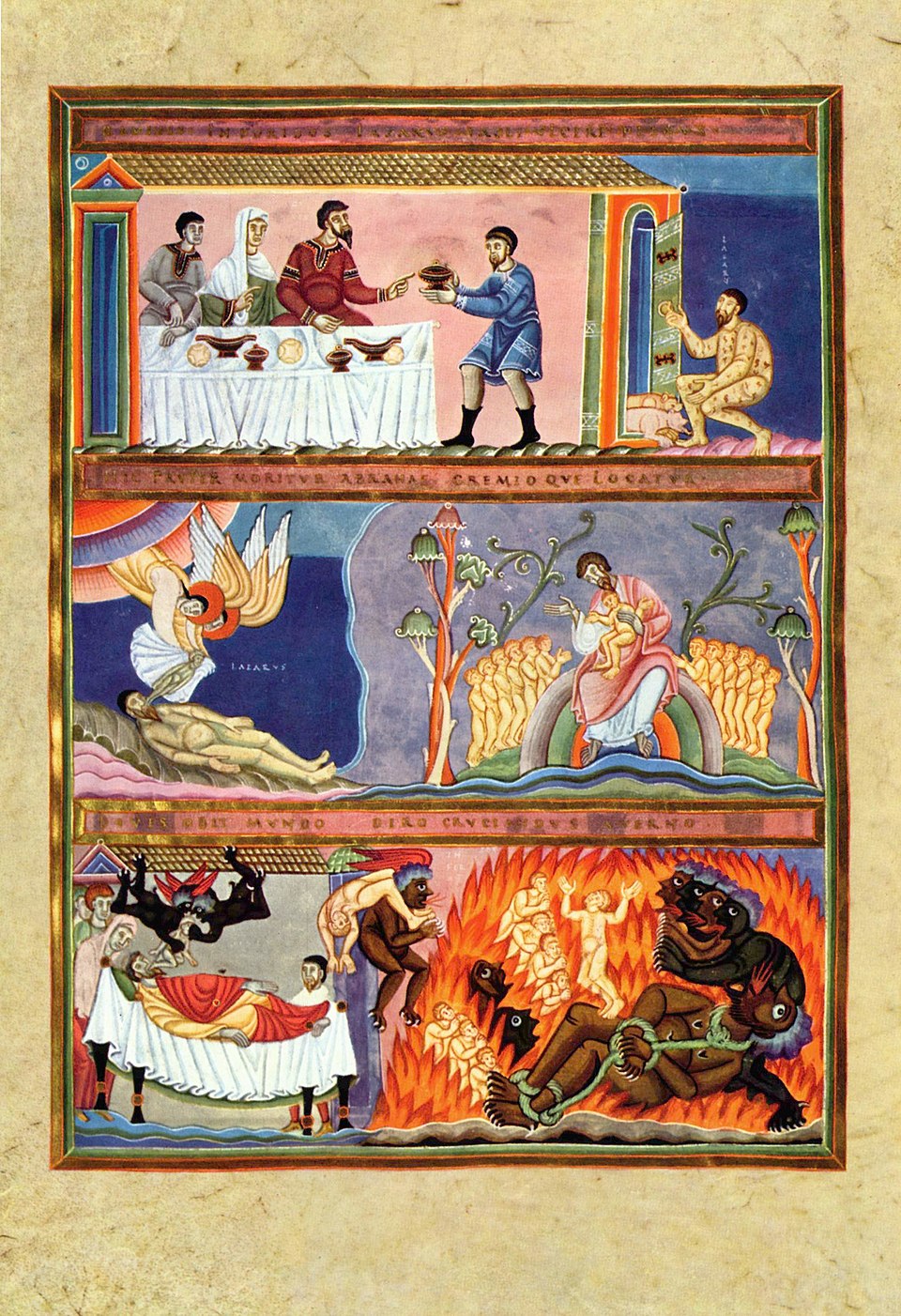
Have you ever read the story of Lazarus and the rich man, and stopped to wonder how Lazarus must have felt on the ground in pain and hunger? Think of him lying there at the end of the rich man’s driveway suffering and half-starved – while the wealthy and the arrogant lived in luxury and pleasure just a few yards away:
“There was a rich man who was dressed in purple and fine linen and lived in luxury every day. At his gate was laid a beggar named Lazarus, covered with sores and longing to eat what fell from the rich man’s table. Even the dogs came and licked his sores.
The story Jesus told suggests that this was an ongoing way of life for Lazarus. He was likely in that situation for a long time, because he laid there until the day he died:
“The time came when the beggar died and the angels carried him to Abraham’s side”.
My question is, “Where was God while Lazarus suffered?” Even if you believe this to be allegory only, there’s no getting away from the fact that God was doing nothing while Lazarus suffered, and Jesus while telling the story didn’t attempt any apologetic to excuse God’s apparent absence and lack of action.
What did Lazarus’ experience do to his faith? Here is Jesus Christ, the man who fed five thousand in one sitting; the Son of God; the One who owns the cattle on a thousand hills and indeed all of the earth, seemingly standing far off, observing the suffering of Lazarus and not stepping into the situation to help. God could have just said the word, and Lazarus would have been well and healthy, strong and prosperous: why didn’t He? Many of our Christian brothers and sisters, and prosperity preachers, will claim that God intends to enrich us in material wealth. All we have to do is hand over a large amount of cash to them, and God will repay us a hundred or a thousand times over. If Lazarus had only parted with his money while he had the chance, he wouldn’t have been in such a predicament. However, this give-to-get, blab-it-and-grab-it mentality is totally ungodly and ignores reality.
NO PRETENCE
One of the convincing features of the Bible is that it describes God without trying to dress Him up as a fairy god-mother of human imagining. Similarly, the people God chose to work through are seen “warts-and-all” throughout Scripture. They’re not made out to be perfect or even particularly good or loveable. Their characters are believable because they display real human traits which we’re all familiar with, and not those of unnatural heroes and heroines. Similarly, situations and stories give the picture of a God with depth of character. It isn’t easy to understand God or His ways because He is infinite. How could we short-term, finite and very fallible mortals, possibly understand Hm? Lazarus certainly didn’t.
THE INNER PAIN
Again, imagine Lazarus scratching his sores and feeling the worms moving around inside his starving body while flies crawled over him and passers-by sneered at him. He could hear the sounds of the rich man partying with his friends. He could see the rich man’s beautiful wife and her lovely, sexy friends swanning around in the gardens. He witnessed cartloads of food and wine being delivered daily, and not a drop was given to him to ease his condition. He was alone, rejected, unloved and completely broken.
Through it all, God was seemingly absent or uncaring. Yet God didn’t miss a thing. He was, in a very profound way, with Lazarus.

THE REALITY OF LIFE
It’s human nature to expect a loving God to want to provide and to bless in physical ways, and sometimes He does. But around the world millions, including those who are believers in Jesus, go without basic needs or who even suffer the trials of persecution, often throughout their lives. It’s clear, then, that God’s intention is not necessarily to bless us all in material fulfillment. He doesn’t plan to make us all healthy, wealthy and wise. He doesn’t give us all power and strength, love and life, fun and fulfillment. Instead, we live in whatever circumstances have been carved out for us by our nations, our families, our health, our friends, our own way of thinking, and any number of other contributors.
JESUS ENJOYS OVERTURNING TABLES!
It’s fascinating that the condition of our lives and the position we are in is potentially the direct opposite of what God truly has planned for us in the world to come. Lazarus was comforted when he died, while the rich man who had lived in luxury and who had apparently no concern whatsoever for Lazarus was separated from the presence of God, and found himself in a place of perpetual pain instead. God had not only poured out that latent compassion upon Lazarus, but also poured out his wrath on the rich man for his utter selfishness.
The rich man had unknowingly been tested throughout his own life. He was tested with riches, success and pleasure. It was easier for Lazarus to find faith and hope than it was for the rich man, because faith and hope was all he had. If we can only soften our hearts in suffering and not harden them, we are guaranteed winners, against all the tangible evidence. The rich man had it all, to the point of thinking that He didn’t need God and didn’t need to help anyone else. We should feel sorry for the ones who appear to have it all and yet ignore their creator. In the case of Lazarus and the rich man, the tables were completely turned once they passed from this world:
The rich man also died and was buried. In Hades, where he was in torment… (Luke 16:19-23).
This principle is seen in many of Jesus’ parables and pronouncements. We don’t end up with great blessing just because we’re poor and rejected now, but because arrogance and pride are removed far from us when we humble ourselves in trials.
“Blessed are you who are poor,
for yours is the kingdom of God.
Blessed are you who hunger now,
for you will be satisfied.
Blessed are you who weep now,
for you will laugh.
Blessed are you when people hate you,
when they exclude you and insult you
and reject your name as evil,
because of the Son of Man (Luke 6:20-22).
THE LESSON
We often feel sorry for ourselves because of genuinely unhappy circumstances. It’s a mystery why some seem to suffer so much more than others. Is this the luck of the draw? Is it the natural and arbitrary outcome of many forces working on our lives? Is it the consequence of living in a fallen and decaying world? Is it the product of our own strengths and weaknesses? Is it the work of the spiritual world around us and in us, including that of God? Or is it perhaps a combination of all these things?
The lesson of Lazarus tells us that we need to take direct and potent action to recognise that God is in our lives even when it doesn’t seem like it. We think sometimes that He doesn’t care, or even that He isn’t there at all. We make the mistake of thinking that our own circumstances are of far more importance than the will of God. Our faith is challenged, sometimes to an extreme extent, and this, I think, is one of the very large reasons why we suffer and struggle.
JOB
Consider the story of Job. He was a righteous man beyond any other of his time, yet the Lord allowed him to suffer greatly, and stood back and watched to see what the result of his suffering would be. Was Job’s faith genuine or not? To be honest, it seems to me that the Lord intended for Satan to test Job’s faith severely. It was He who drew Satan’s attention to Job in the first place. The instigator was not Satan:
Then the Lord said to Satan, “Have you considered my servant Job? There is no one on earth like him; he is blameless and upright, a man who fears God and shuns evil” (Job 1:8).
I’m not saying that every time we suffer it’s because those in the unseen world wish to test us. There are numerous reasons for suffering. However, it’s clear from the examples of Lazarus and Job that we are indeed tested, even when the cause of suffering is not spiritual. How will we react? Do we really have faith, or is our profession only that: words which are easily abandoned when the going gets tough? Do we really love God, or are we only in it for the money?
 Fuel for Faith, Food for Thought