
It’s widely believed or recognised that Jesus had a special love for John above all his disciples. John was, after all, “the disciple whom Jesus loved” (John 13:23). What does this mean? Does it mean, as some claim, that there was some sort of homosexual tension or even interaction between the two?
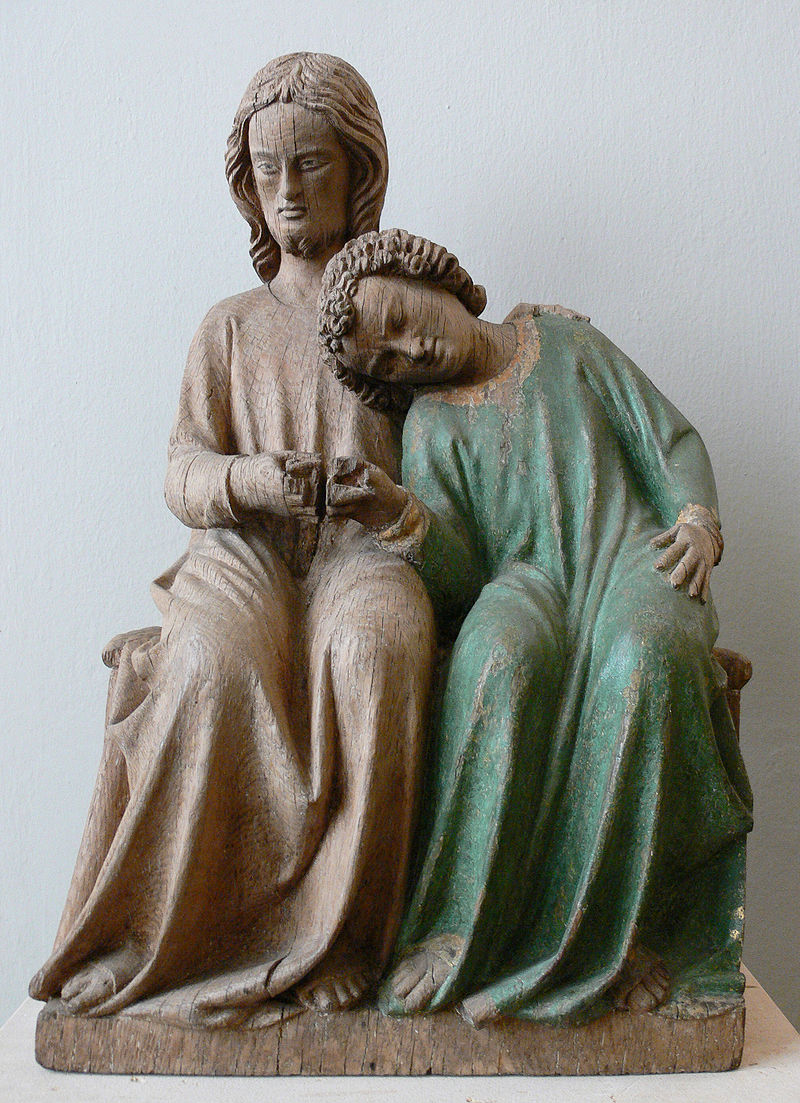
There’s no way of tiptoeing around this question, at least in any Biblical analysis. Not a word of any physical attraction or engagement between believing Biblical characters is to be found anywhere in the texts of any of the gospels or the rest of the New Testament. John’s gospel – written by the disciple Jesus loved – does not contain any description of Jesus’ physique, his appearance, his looks, or any suggestion that John was attracted to him or vice-versa, unless you’re intentionally reading into the text. The same can be said about John’s letters.
My comments are not intended to be judgmental. We all fall short of the glory of God, including and especially me, and it’s only our repentance and the sacrifice of Jesus which can restore us.
PURITY
The truth of the matter is that the world – the world of humanity that we have to live among but which Jesus said was not his kingdom – has the habit of sexualizing everything. The beauty of love (and also that of sex) i s tarnished, trashed and cheapened by the mind of man. Paul, as was his habit, put it succinctly this way:
“To the pure, all things are pure, but to those who are corrupted and do not believe, nothing is pure. In fact, both their minds and consciences are corrupted” (Titus 1:15).
NO EQUATION
Sex is not love: the two terms are not synonymous. Yes, love must be at the heart of Godly sexual expression, but the two are not the same thing. You can love someone without having sex with them. You can love someone without thinking of them in terms of physical contact or body shape, and you can love someone on a much deeper level than the desire for physical gratification.
I’ve had people with same-sex attractions ask me rhetorically why their kind of love should be considered to be wrong; why they should not also express love to each other. My answer is that you can and should love each other. You can even recognise the beauty and character of another. After all God, the Artist, created humanity in beauty and perfection and called it “very good”. The problem comes in confusing love and affection with sex. The word “love” is frequently and commonly used as a euphemism, an excuse, an opportunity, a justification, a sham and a persuasion to achieve far less noble ends.

THE FULFILMENT OF LOVE?
The response to any such clarification of terms is usually that sex is the natural expression and fulfillment of love. When you love someone you just can’t help proceeding in the relationship to sexual involvement. Really? Not wanting to be course or insulting, I could ask if you have sex with your relatives – surely you love them? Presumably, unless you have a very serious problem which you need medical help with, you didn’t express your love with sexual intimacy.
I’m a man and I think like a man. I know what it is to think those sinful thoughts about women I meet who I find attractive, and if you say you haven’t experienced that you’re probably lying. But when I have those thoughts, in my knowledge of God’s holiness and His Word, I push them out and deny them access to my consciousness. Why? Because Christian love and genuine, godly love is not sexual. There is one exception. As Paul described, physical intimacy within marriage between a man and a woman is “holy and undefiled”. That’s it: all other sexual relationships are unholy and in opposition to the will of God. If you can’t see that or agree with it, you are either intentionally in sin or you don’t know the God of the Bible at all: you’re just pretending you do.
LOVE ALL ROUND
Jesus Christ loved all his disciples, and his love was to be a model for all believers to follow:
“A new command I give you: Love one another. As I have loved you, so you must love one another. By this everyone will know that you are my disciples, if you love one another” (John 13:34).
Do you really think that Jesus was here promoting physical intimacy among all believers? Of course he was not.
HAVING FAVORITES
What about that special relationship which Jesus and John apparently had? It’s very possible that John was Jesus’ “favorite” disciple. We all have favorites in life, without having sex with them Jesus and John may have had a unique rapport – a way of communicating or seeing things that the others didn’t have. John’s contribution to the New Testament is unique, considering the fact that John was chosen to receive the Revelation. Alternatively, when we read of Jesus’ love for John we read it in John’s gospel. John loved Jesus intensely – as his Lord – and perhaps saw himself as Jesus’ favorite, when in reality Jesus loved them all equally.
JESUS LOVED OTHERS TOO
Mark recorded an account of a rich man asking Jesus about how to gain eternal life. When the man said he had kept all the commandments from his youth, “Jesus looked at him and loved him” (Mark 10:21). Jesus found the man’s attitude endearing, even though he was unable to part with his wealth. Perhaps there’s a clue here as to Jesus’s affection for John. There’s absolutely no reason to read anything of a physical nature into this passage, unless that is, your mind is so corrupted by the world that you assume it’s the natural outcome of any encounter evoking affection.
The sex drive in some of us is indeed powerful, but our God demands that we master it and express it in His way only – that is, in marriage with someone of the opposite gender. Don’t think for a moment that Jesus Christ, who knew no sin, failed in that regard. IF you do, you need to repent. You need to see Jesus Christ as the holy, sinless and perfect God-man, who alone was worthy to pay the price of our own sin.
 Fuel for Faith, Food for Thought