
You may have heard people – even apparently well-educated people – insist that Jesus Christ never existed. His life and his teachings are just mythical they say, invented and then augmented over several centuries for various reasons. Most commonly the suggested motivation was to use “religion” as a tool for the subjugation of masses of gullible people. You may even have this view yourself.

I’ve known for a long time that this assertion is nothing more than wishful thinking, or it’s just a parroting of the claim from someone who doesn’t know any better. I’ve been looking at this subject afresh over the past week as I do from time to time, and I here share a portion of what I’ve come across in defense of the real Jesus.
EXTRA-BIBLICAL SOURCES
In a video produced by Brandon McGuire on his channel “Daily Dose of Wisdom” (1), Dr Nabeel Quresh speaks of independent historical facts attesting to the life, death and resurrection of Jesus. The New Testament and subsequent writings of the Church Fathers are in themselves powerful testimony, but for those who are not willing to accept these due to what they see as bias, Nabeel explains that apart from these sources “We have over forty records of Jesus’ life from ancient times”. Very few scholars, even skeptics and atheists or those of other faiths, now claim that Jesus never existed. They all conclude that a man called Jesus lived his life and died on a cross under Pontius Pilate.
McGuire gives examples of extra-Biblical references to the life and times of Jesus. Here are a few of them.
THE TALMUD
In the first century Jews who were hostile to Jesus and were certainly not his followers, wrote:
“Jesus was a magician and a fool”.
“Jesus performed magic and incited the people of Israel”.
“On Passover eve they hanged Jesus. He practiced sorcery and incited and led Israel astray”.
TACITUS
Tacitus was a first century Roman historian and politician, and certainly not a Christian. He wrote, “…. Christos, from whom the name had its origin, suffered the extreme penalty during the reign of Tiberius, at the hand of Pontius Pilate”.

JOSEPHUS
Flavious Josephus was a first century Jewish priest, scholar and historian. He wrote in his “Antiquities”, “At about this time there lived Jesus, a wise man… He wrought surprising feats. He was the Christ. When Pilate condemned him to be crucified those who had come to love him did not give up their affection for him…”
Thomas Scmidt, a graduate of Yale, states that Josephus mentioned other New Testament persons in his works, including Pontius Pilate, Caiaphas, Herod Agrippa, Herodias, Annas the High Priest and John the Baptist. Some critical scholars have insisted that while Josephus did mention Jesus, the part about Jesus being the Christ was probably added later, but Schmidt affirms the validity of these words in his book, “Josephus and Jesus: New Evidence for the One Called Christ” (4).
LUCIAN
Lucian was a 2nd century Greek satirist. Here’s what he wrote:
“The Christians worship a man to this day – the distinguished personage who introduced their novel rites and was crucified on that account. (It) was impressed upon them by their original lawgiver that they are all brothers from the moment they are converted, and deny the gods of Greece and worship the crucified sage, and live after his laws” (1).
THE TESTIMONY OF GARY HABERMAS
Gary Habermas, a New Testament scholar, has devoted his life to demonstrating the validity of the central New Testament message of the life, crucifixion and resurrection of Jesus Christ. He likes to share how the vast majority of serious scholars including atheists, skeptics and those of other philosophies affirm that Jesus lived, and that his followers of the first century believed and taught the gospel. Habermas gives some examples in a video titled “The Best Historical Sources for Jesus – Gary Habermas”. Habermas states that there’s been something of a reformation in the past decade, with a majority of scholars admitting to very early first century dates for central Christian doctrines.
In his book “The Historical Jesus “ John Dominic Crossan, an Irish scholar and theologian, gave a list of multiple early references – pages of them – relating to the life of Jesus, including the resurrection.
Atheist New Testament scholar Barth Ehrman in his book, “Did Jesus Exist?: The Historical Argument”, wrote that those who call Jesus a “myth” and say he never existed don’t know what they’re talking about. Ehrman lists fifteen independent sources for the crucifixion of Jesus just within the first hundred years of the event. A number of those were not Christians and are not in the New Testament. He affirmed that New Testament sources are legitimate and accredited. While Ehrman is not himself a believer, he wrote that the earliest Christians taught truths central to the divinity of Jesus, and are found to within a year or two of the cross.
I shared in a recent post the following:
Habermas tells us that according to a consensus of New Testament scholars, including atheists and skeptics, Luke’s gospel was written down around 85 AD. John MacArthur gives reasons why it was more likely written around 62 AD. In videos such as, “The Early Creeds and Their Historical Significance, with Gary Habermas” Gary stresses the fact that almost all New Testament scholars, whatever their beliefs, now concede that the central points of the Christian gospel were being taught and recited very early on in the first century, even before the first gospels were written down. These included the conviction that Jesus Christ was the Son of God. The claim that this was an idea invented in subsequent centuries and then pushed on the Church at Nicaea is not at all valid. Most of these first century creeds were identified by critical scholars, not by evangelicals.
Famous theologian James DG Dunn, in a book “Remembering Jesus”, wrote that the earliest credal statements found in the New Testament-and elsewhere-on Christ’s resurrection and post-resurrection appearances-probably began circulating within months of the event.
In “The Best Historical Sources for Jesus” concerning the writing of the gospels, Habermas tells us that the status quo – the commonly held view among scholars concerning the dating of the gospels – is that Mark was written in 70 AD, Matthew 80 AD, Luke 85 AD and John 95 AD. The earliest New Testament document is probably 1 Thessalonians, dating to 50 AD – just twenty years after the cross. Gary mentions two agnostic scholars who, like himself, put the date of Mark at 40 AD and Matthew at 50 AD.
THE MEGIDDO MOSAIC
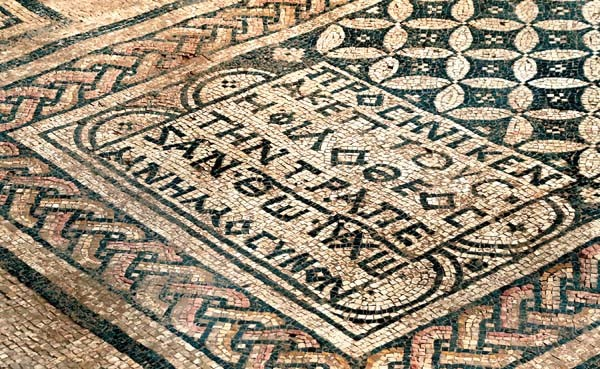
I know this is almost old news now, but I’ve been reviewing it and finding it fascinating. A mosaic measuring 16 by 32 feet has been uncovered in ancient Megiddo in northern Israel and is now on display at the Museum of the Bible (2). The mosaic covered the floor of a Christian worship hall. It is dated to 230 AD. Of the three inscriptions the one of greatest importance is the Akeptous Inscription, which contains the phrase “God Jesus Christ,” and was inscribed nearly a century earlier than the Council of Nicaea.
THE JESUS DISCOVERIES
Dr Jeremiah Johnson is an enthusiastic proponent of the validity of the Shroud of Turin as the actual burial and resurrection cloth of Jesus. I’ve written about this before. Johnson claims that he can present sixty-five historical facts of the life of Jesus from extra-Biblical sources. Here I want to highlight two artifacts discussed in his new book, “The Jesus Discoveries”.
THE JESUS CUP
An object Johnson calls “The Jesus Cup” was found by Frank Boggio, a marine biologist, during a dive near Alexandria in 2008. Dated to the mid first century, the inscription on the cup is translated, “Through Christ the Magician”. Johnson tells us that Jesus was known to have been a miracle worker, so his name was invoked in incantations and blessings even by those who had no interest in his teachings and his claim to be the Son of God.
THE JESUS PAPYRUS
Stored in the Magdalene Library at Oxford University is “The Jesus Fragment” of papyrus. It’s actually in three pieces, it was found in Luxor, Egypt, and it’s the oldest fragment of the gospel of Matthew, dating to sometime between 100 and 200 AD. The Jesus Fragment includes the name of Jesus in several places (3).
CONCLUSION
Today I’ve only scratched the surface of the available subject matter. So much more could be discussed, including the many archaeological finds in Jerusalem which confirm the narrative of the Bible. This post is just a sample to show clearly that Jesus really lived. Since this is the case, we are all faced with a decision. On one occasion Jesus’ disciples were sharing what people were saying about him, and he said:
“But what about you?” he asked. “Who do you say I am?”
Simon Peter answered, “You are the Messiah, the Son of the living God” (Matthew 16:15-16).
NOTES
1 YouTube video: Jesus Was NOT a Myth (15 minutes of Evidence)
https://www.biblicalarchaeology.org/exhibits-events/the-megiddo-mosaic/
3 YouTube video: THESE NEW ARTIFACTS PROVE JESUS EXISTED with Michael Knowles.
See also the video: THE EARLY CREEDS: Historical Facts About Jesus from 30 AD to 55 AD.
4 From a YouTube video: “Breaking: The Earliest Non-Christian Testimony to Jesus May Be Authentic”
 Fuel for Faith, Food for Thought
Amen!
I truly enjoyed reading this.
LikeLiked by 1 person
Thank you Julie, I enjoyed writing it!
LikeLike