
When you hear people make claims such as “Jesus Christ never existed” you find yourself being challenged. You’ve been a professing believer for X years, you go to church, you shape your life at least loosely around what you claim to believe, but you’ve never taken the trouble to find or memorize hard historical or archaeological evidence to back up your faith. With an awareness of this common failing in the back of my mind I recently benefitted from a podcast produced by the Associates for Biblical Research, titled, “Jesus Outside the Bible – The Top Ten Historical References” (1).

ABR produces many such faith-supporting and faith-boosting podcasts, and I’ve found them to be thoroughly Biblical and trustworthy. I here summarize the discussion of this video.
EXTRA-BIBLICAL EVIDENCE
Staff member Bryan Windle explains to podcast host Henry Smith that while New Testament gospels are the most reliable and earliest documents about Jesus – being written by eyewitnesses or people who interacted with eyewitnesses – a common demand from skeptics is for extra-Biblical evidence. Windle asserts that it’s difficult to explain the explosive growth of Christianity in the first century if Jesus didn’t exist.
In compiling his top ten extra-Biblical references Windle used the following criteria: 1/ Sources must be from the first or second centuries – close to the time of Jesus’ life – and 2/ They must be references to Jesus and not just to early Christians. Here then are Windle’s top ten, listed from significant to the most significant of all. I have written my sub-headings on the same lines as my script in the hope of stopping WordPress ads separating the two.
NUMBER 10: EARLY CHRISTIAN WRITERS, CA 50 – 157 (The remaining nine references are from non-Christian writers). Clement at Corinth in the first century wrote about the teachings of Jesus and his death and resurrection. Ignatius of Antioch wrote a letter to Smyrna claiming that Jesus was crucified under Pontius Pilate and Herod the Tetrarch, and that Jesus, “Suffered all these things for us, and he suffered them really and not in appearance only, even as he truly rose again”.
Polycarp wrote a letter to the Philippians about Christ, Polycarp being one of the people who learned from the apostles. Justin Martyr wrote that Jesus was a teacher, that he was crucified and that he rose again. Papias wrote that he was passing on what he had been taught about Jesus from eyewitnesses.
Quadratus was an early Christian apologist. He wrote a letter to Emperor Hadrian about the “genuine” works of “our Savior”, noting that some had been healed and raised from the dead, and even saying that some who were raised were still alive in his time.
NUMBER 9 PHLEGON. The following non-Christian writers confirm the information shared by Christian writers noted above. Number nine in Windle’s top ten is Phlegon. Phlegon of Tralles wrote a book of history in the middle of the second century. His book didn’t survive but it was quoted by others. Origen quoted several passages, referring to Christ as having a knowledge of future events which actually came to pass, such as an eclipse and the great earthquake which occurred at the time of the crucifixion. Phlegon had written of Jesus’ resurrection, and how Jesus showed his nail-pierced hands. Phlegon also recorded that Jesus was crucified in the days of Tiberias Ceasar.
NUMBER 8: THALLUS. Thallus was a non-Christian writer who in 55 AD referred to events surrounding the crucifixion. Though his work is lost, Julius Africanus quoted Thallus, writing of the darkness which overtook the land at the time of the crucifixion of Jesus and of the earthquake which occurred as described in the gospels. The darkness, said Thallus, appeared to be an eclipse without reason; an eclipse of the sun.
NUMBER 7: CELSUS. Celsus was a second-century Greek philosopher who wrote a treatise attacking Christianity. Later Origen wrote a rebuttal summarizing Celsus’ arguments. Celsus had imagined a Jew in a dispute with Jesus over several things. In this dispute Celsus attacks the idea of the virgin birth and demeans Mary’s work as a mere spinner. Celsus’ “Jew” claims that Mary was rejected by Joseph for adultery. He asserts that Jesus acquired some miraculous powers in Egypt and used them erroneously to claim divinity.
NUMBER 6: LUCIAN. Lucian of Samosata was a famous Greek satirist. He mocked Jesus in his work, “The Death of Peregrine”, written around AD 165. He wrote that “Christians worship a man to this day, the distinguished personage who introduced their novel rites and was crucified on that account”. Inadvertently, therefore, Lucian confirms for us some important facts about the life and death of Jesus. As Henry Smith observes, “Hostile witnesses are our friend”.
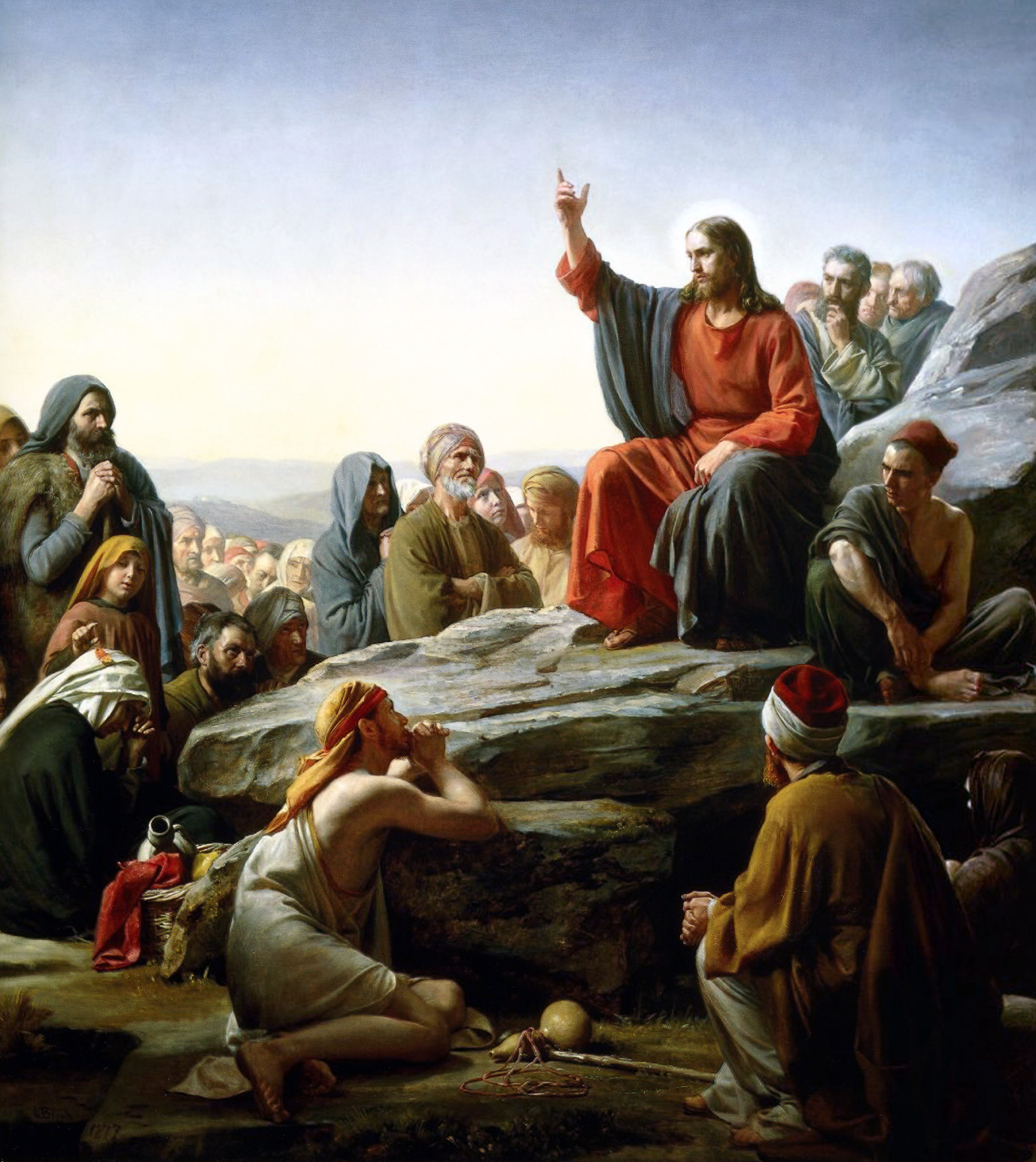
Carl Bloch, 1890
NUMBER 5: MARA BAR SERAPION, CA 73 AD. Mara Bar Serapion was taken captive by the Romans when they destroyed his Syrian city. From prison he wrote to his son, urging him to pursue a life of wisdom. He wrote of the murder of Socrates and how famine and pestilence repaid their action. He wrote about the death of Pythagoras at the hands of the people of Samos, who were subsequently destroyed by a flood. In the same vein he wrote of the murder of a wise king by Jews. This murder, wrote Mara, was followed by the destruction of their kingdom.
Mara Bar Serapion did not specifically mention Jesus, but the reference is clear. The only “wise king” of the Jews who lived anywhere near the time of the destruction of Judea at the hands of Rome, and who was killed by the Jews, was Jesus Christ. The title, “King of the Jews” was used by Pilate and the Roman soldiers: it was the Jews who wanted him dead.
NUMBER 4: PLINY THE YOUNGER. In AD 112 Pliny the Younger, a governor of Bithynia, wrote to Emperor Trajan asking for advice on how to deal with Christians he was prosecuting. He was attempting to get the Christians to curse Christ and only worship the Roman gods. In one letter he wrote, “They declared that they had been accustomed to meeting before daybreak to sing a hymn to Christ, as though he were a God”. These Christians had made an oath to abstain from such things as theft, breach of faith and adultery.
Trajan’s response included a direction that if they would not curse Christ but were going to continue to worship him as God, “you need to prosecute them”.
NUMBER 3: SEUTONIUS. Suetonius, a Roman historian, writing about events during the time of Claudius, said, “Since the Jews constantly made disturbances at the instigation of Chrestus, he expelled them from Rome“. This is mirrored in the book of Acts. Chapter 23 records a letter to governor Felix from Claudius in defense of Paul, whom the Jews were attempting to stop in any way possible (Acts 23:12-22). Windle says that the term “Chrestus” or “Chrestos” was a tern used by Christians and even a couple of early church fathers for Christ.

NUMBER TWO: FLAVIUS JOSEPHUS. Jewish historian Josephus lived in the first century. He mentioned Jesus twice in his work, “The Antiquities of the Jews”. One passage is controversial among scholars (probably because it’s so forthright about the name and work of Christ). In one copy found in Egypt in 1970 Josephus writes this:
“At that time there was a wise man who was called Jesus….. “Many people from among the Jews and other nations became his disciples. Pilate condemned him to be crucified and die, but those who became his disciples did not abandon his discipleship. They reported that he had appeared to them three days after his crucifixion and that he was alive accordingly”.
In another reference to Jesus Josephus mentioned the death of James, “the brother of Jesus, who was called Christ”.
NUMBER 1: TACITUS. Tacitus was a Roman historian. In “Annals” he wrote how Nero had blamed the great fire of Rome onto the Christians. Tacitus said that “Nero fastened the guilt and inflicted tortures on a class hated for their abominations called ‘Christians’ by the populace. Christus, from whom the name had its origins, suffered the extreme penalty during the reign of Tiberius at the hands of one of our procurators, Pontius Pilate, and a most mischievous superstition”.
Windle believes the “mischievous superstition” Tacitus referred to was the resurrection of Christ.
WINDLE’S SUMMARY AND CONCLUSION
Windle summarizes what we can know about Jesus Christ from non-Christian, extra-Biblical sources:
Jesus was reported to have been born of a virgin. His father was a carpenter. He was a teacher and his disciples passed on his teachings. He prophesied. He performed miracles. He was known for his wisdom and for living a virtuous life. He claimed to be God. He was crucified under Pontius Pilate during the reign of Tiberius Ceasar.
Darkness and earthquakes followed his death. His followers reported and believed that he had risen from the dead, that he had appeared to them alive, and showed them the wounds in his hands. His followers worshipped him as God and were prepared to face persecution for that conviction. Such disturbances were caused with the unbelieving Jews that Claudius had to evict the Jews from Rome.
This summary affirms the gospel and the story told in the New Testament. The wise response is to seek the mercy God offers through His son Jesus Christ, and to believe the gospel of Christ’s death for our sins, and his bodily resurrection.
1/ YOUTUBE VIDEO: Jesus Outside the Bible – The Top Ten Historical References: Digging for Truth Episode 222.
 Fuel for Faith, Food for Thought
Thank you!!! I will forward this to friends.
LikeLike
So pleased to be of help. It helped me too!
LikeLike