
I recently wrote about free will in relation to faith using reason only, promising to consider Scripture very soon. So now I offer what I consider a Biblical viewpoint on the matter.

TWO VIEWS OF A BIBLE
Of course, the ardent Calvinist will protest that his view is the Biblical one. And herein is one of the problems with Calvinism for me. By telling us what certain passages of Scripture “really” mean, rather than what they most obviously mean at first read, those with the Reformed perspective have the habit of looking down their noses at the rest of us, and of accusing us of not knowing our Bibles. The truth is that it’s a matter of opinion and interpretation, and not one of stupidity or ignorance. My opinion is that the Son of God died for all-not just for some-and I will take those most obvious readings of Scripture with this in mind, being fully aware of what the other interpretation is.
This principle should be applied, I’m convinced, to other so-called “debatable” issues, such as Creation. If someone is telling you what Scripture “really” means, even though the same obvious thought is repeated in several passages of Scripture, they are likely trying to introduce you to what they wish Scripture to say, rather than what it most clearly does say.

AMATUER THEOLOGY
I do not claim to be any kind of theological expert, and this post is not at all intended to be an exhaustive or scientific examination of the subject. Calvinists like to use many technical and hi-brow terms for simple principles or ideas. If you want to study the “experts”- good luck. Experts are often really people who have had a whole lot of education and experience in the art of backing up a falsehood. Again, evolutionism is a perfect example of this.
DISCLAIMER
If this post is too long for you, scroll down to sub-headings which take your fancy.
At the outset I want to make clear to anyone leaning on the side of Calvinist doctrine, that I completely believe and acknowledge that without the work of the atoning sacrifice of Jesus Christ, and apart from the mercy of God, we are all totally lost in our sin, and doomed to destruction. The question is not about our depravity, it’s about whether, how and why we come to salvation from that depravity.

TWO VIEWS OF A STATEMENT
For God so loved the world, that he gave his only begotten Son, that whosoever believeth in him should not perish, but have everlasting life (John 3:16) KJV).
The most obvious takeaway from this verse is that Jesus Christ died for everyone, and that whoever places their hope and trust in Him has everlasting life. That is my firm conviction.
How does the Calvinist explain away such all-encompassing grace and generosity? He says that since we can only be saved by faith and not by works (an entirely Scriptural statement) we cannot come to faith unless God gives faith to us, otherwise faith would be a “work”. In this view they strip the believer of free will. You can only come to God if He makes you come to him-otherwise you have no chance, according to the Calvinist. You cannot “seek” God unless He programs you to seek. To me this is an intentional confusion of terms and denial of true meaning.
If we made our own choice, that faith would be a “work”? Why then did Paul differentiate between faith and works? The two are incompatible, says Paul. It makes no sense to accuse someone that their faith is really a work in disguise. I can trust that the pilot of a plane will deliver me safely to my destination, but I’m not going to build the plane, fly the plane, or navigate it: I’m just going to get on it and sit down.
CHOOSING SOME AND NOT OTHERS?
Does God only call some people and not others? This is the (usually) tacet implication of Calvinistic thinking. Your family members are ignoring Christ because the Lord has not called them-he has only called you and has only imparted faith to you. Why? If, in the no-free-will mindset you are so depraved and utterly abhorrent to God because you are another fallen human, why would the Lord choose to call you and not your family members? Why indeed, and so far as I know there is no clear answer to this-it’s all up to the Lord’s infinite mind, who alone has free will. However, in a clear and simple reading of many passages of Scripture, the opposite is true:
And I, if I be lifted up from the earth, will draw all men unto me (John 12:32 KJV).

Jesus said he would draw all men (people) and not just some. I’m sure the Calvinist has a way of explaining what Jesus “really” meant here by “all”, but I’m not buying it. Why would a God who “so loved the world” only wish to save a small percentage of people but send the rest to an eternal hell with no possibility of salvation? If we’re all in total depravity-we are all equally guilty. So surely a God who loved the whole world, and who is abundant in grace and mercy, would want to save everyone, and fill His heaven.
The message of the early Church was consistent with the clearest understanding of the above verse. Here is Paul’s message to the Thessalonians:
“… now he commands all people everywhere to repent. For he has set a day when he will judge the world with justice by the man he has appointed. He has given proof of this to everyone by raising him from the dead” (Acts 17:30-31).
What’s the point in giving proof to all men only to send them to destruction? If they were not able to seek the Lord or come to faith by free will, why are they going to be eternally judged? Isn’t this gross spite and an overbearing vindictiveness on the part of the creator of us all? No chance of repentance for most humans-is this really a loving God? No, this was not Paul’s message to the world. Here’s what he had to say to Timothy on the subject:
I urge, then, first of all, that petitions, prayers, intercession and thanksgiving be made for all people— for kings and all those in authority, that we may live peaceful and quiet lives in all godliness and holiness. This is good, and pleases God our Savior, who wants all people to be saved and to come to a knowledge of the truth (1 Timothy 2:1-4).
According to Paul, God wants all people to be saved and to come to a knowledge of the truth. This, again, is consistent with the words of Christ himself, who said that he would draw all people to himself, not just some. Peter’s view was the same:
Instead he is patient with you, not wanting anyone to perish, but everyone to come to repentance (2 Peter 3:9b).
John’s view was similar. He said of Christ:
He is the atoning sacrifice for our sins, and not only for ours but also for the sins of the whole world (1 John 2:2).

NUMEROUS EXAMPLES OF FREE WILL IN SCRIPTURE
The passages clearly indicating choice-free will-are numerous. To claim that this free will is a verbal covering for the lack of free will is saying that there is deception in the word of God. I will share a few examples here:
They perish because they refused to love the truth and so be saved (2 Thessalonians 2:10b).
Paul spoke here of “refusing” to love the truth. If you can refuse the gospel, you can accept it:
With many other words he warned them; and he pleaded with them, “Save yourselves from this corrupt generation.” Those who accepted his message were baptized, and about three thousand were added to their number that day (Acts 2:40-41).
Was Peter unaware of the lack of free will in his audience? If he believed in election by the choice of God only, he should never have said something like “save yourselves”.
God did this so that, by two unchangeable things in which it is impossible for God to lie, we who have fled to take hold of the hope set before us may be greatly encouraged (Hebrews 6:18).
By the reasoning of the Calvinist, we can’t “flee” from sin unless God makes us flee. This makes us into automatons, having no choice as to whether to sin or to reject sin.
From one man he made all the nations, that they should inhabit the whole earth; and he marked out their appointed times in history and the boundaries of their lands. God did this so that they would seek him and perhaps reach out for him and find him, though he is not far from any one of us (Acts 2:26-27).
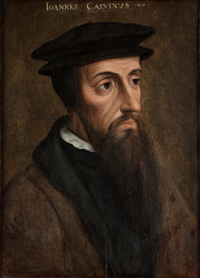
Does the Lord “make” some people seek him and reach out for him, but not others? That’s not the message of this passage, or any other for that matter, unless you insert it yourself. And the gospel, outlined by Paul in the letter to Romans, heavily stresses the will to accept it. You really have to wrestle with this text to break it away from an obvious statement of the need for free will:
“The word is near you; it is in your mouth and in your heart,” that is, the message concerning faith that we proclaim: If you declare with your mouth, “Jesus is Lord,” and believe in your heart that God raised him from the dead, you will be saved. For it is with your heart that you believe and are justified, and it is with your mouth that you profess your faith and are saved (Romans 10:8-10).
CALLED, CHOSEN, PREDESTINED
Where the Calvinist makes the greatest number of converts, besides insisting that faith by free will is a “work” and therefore not real faith, is in Paul’s writings on predestination. If we are “predestined” to be conformed to the Son of God, reasons the Calvinist, then obviously some have been chosen to be saved, and some to be damned. Here’s a related passage:
For those God foreknew he also predestined to be conformed to the image of his Son, that he might be the firstborn among many brothers and sisters. And those he predestined, he also called; those he called, he also justified; those he justified, he also glorified (Romans 8:28-30).
I discussed this text with an ardent preacher of Calvinism. His view was that the text states that God picked certain of us to be saved long before we were born. He “chose” some humans to know Jesus, and by implication chose a far greater number to live a short life and then go to hell without end. He “called” true believers long, ago, but didn’t call the others.
I gave my view of this text to my Calvinist friend, and judging by the brief silence and blankness on his face before he continued, it was something of a challenge and a surprise to him. I think that in his superiority, he assumed I would have no defense for my position.
My explanation was first of all that God knows the end from the beginning. He knows the future of all things. I must stress here though that He does not make everything happen: he just sees it all. He is also able to work His will through all eventualities to bring about the ends He desires. He knew all along who would willingly come to Him. He decided that all those who were going to accept Him-anyone who would accept Him- would be the called, the chosen and the justified.
WAS PHAROAH CREATED FOR DESTRUCTION?
One common matter discussed within the subject of predestination is the record of Pharoah who would not let the Israelites go, as recorded in Exodus. God “hardened Pharoah’s heart”. This hardening is often interpreted as an arbitrary decision on God’s part to make Pharoah into an unbeliever, and to punish him. Instead, we can see this decision as God’s foresight. Since He knows the end from the beginning, He already knew-before Pharoah was born-that Pharoah was going to oppose Him and His people to the end. However, it would be perhaps better to see this as a duel of wills in real-time. As the Lord pressured Pharoah to submit and release the Israelites from their bondage, Pharoah’s heart instead became harder and harder-because of his pride and arrogance-so that the Lord decided to push Pharoah’s will all the way to its destruction. “You want to resist my will? Then you will receive from me far more than you bargained for”.
The Lord will woo us, call us, speak to us, nudge us, and even push us. However, if we continually reject and resist and fight His will, He will give us or surrender us to what we deserve and what we’re asking for: our own failure and destruction. This was the fate of Pharoah: not that he was born to fail and die miserably and go to hell for eternity, but that his determination to reject the will of God would lead to his downfall. You can’t beat God. You cannot win. You cannot use your will to fight Him with any success whatsoever: you will suffer the consequences. Israelites in the wilderness were suffering the consequences of their own free-will decisions:
…do not harden your hearts
as you did in the rebellion,
during the time of testing in the wilderness,
where your ancestors tested and tried me,
though for forty years they saw what I did.
That is why I was angry with that generation;
I said, ‘Their hearts are always going astray,
and they have not known my ways’
So I declared on oath in my anger,
‘They shall never enter my rest (Hebrews 3:8-11).
FAITH, EFFORTS’ WORKS
The preaching of Jesus Christ that men should repent and believe makes no sense if the people he preached to had no ability to do so. The gospels and letters are rich with admonitions and pleas to take the correct path in life. This may be the subject of a subsequent post of mine. I will here quote one such admonition, from the words of Jesus Christ himself:
“Make every effort to enter through the narrow door, because many, I tell you, will try to enter and will not be able to” (Luke 13:24).
The fact that some will try to enter but will not be able to is the consequence of their unwillingness to enter through the narrow door which is Jesus Christ. Notice Jesus’ instruction to “enter” through that narrow door. Entry requires effort or at least a decision to move in a certain direction. If we are placed inside the Kingdom without our will, there is no need for Jesus to tell us to enter.
Salvation is entirely the work of Jesus Christ on the cross. His sacrifice paid the price of our sin, and his resurrection opened the way for us to receive eternal life. However, he will not force us to enter that life: our hearts must be willing to accept his sacrifice, by thought, word and deed.
 Fuel for Faith, Food for Thought