
You are not just another primate. The story of human evolution is only that-a story-and behind all the mainstream hype are many calling attention to the exact opposite of that story. These people, often highly educated and experienced, are kept out of the limelight and shouted down. Casey Luskin is just one of the many telling a different story.
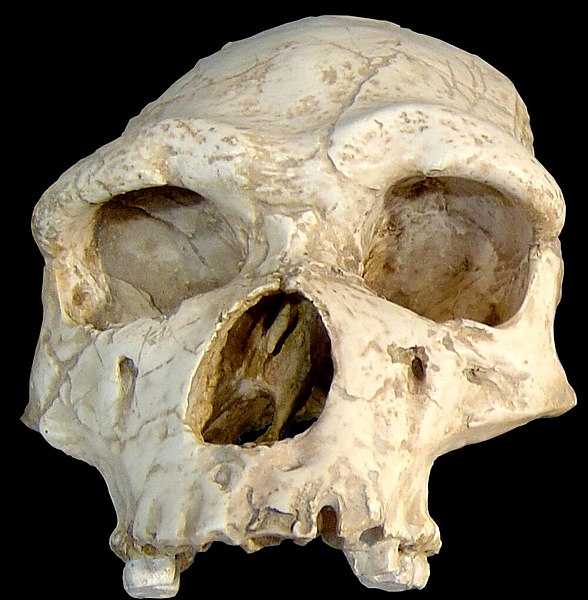
Casey Luskin, PhD., lived in South Africa for four and half years while he studied for his doctorate in Geology at the University of Johannesburg. There he learned about and carried out research on some of the famous hominid fossils at “The Cradle of Humankind”. This is a site north of Johannesburg where perhaps the best museum of hominid fossils in the world is located. In a video titled, “The Unique Origins of Humanity in the Fossil Record”, which I’m summarizing here, Luskin shares some pictures of these fossils and answers the claim that there is adequate evidence humans are descended from ape-like ancestors.
Please forgive me for any ugly ads or gaps inserted in this post by WordPress software.
THE EVOLUTIONARY VIEW OF HOMINID FOSSILS. Luskin tells how he took part in a debate at the Texas Board of Education which discussed to what extent human evolution should be taught in schools. One prominent scientist testified that we should only teach evolution. He argued that there are no gaps in the fossil record linking ape-like ancestors to humans-obvious evidence to him that there’s a clear line of evolution. Luskin believes this expert was being “honest” but wrong. Many secular scientists in technical literature have testified that there are gaps in the fossil record between ape-like and human-like species, some of which Luskin brings to light in the video. He notes that there is one story of evolution told to the public in outlets such as National Geographic documentaries or the news media, which all present “a very simplified, dumbed-down version of evolutionary history, saying that we’ve got it all figured out…” However, when you dig into literature on hominid fossils you find many admissions of large-scale gaps and problems with the evolutionary scheme. Luskin presents some of those problems.
Luskin summarises the evolutionary timeline of claimed human evolution. Five to eight million years ago the first species which supposedly started to walk upright branched off from chimpanzees and others and started a new lineage which led to humans. Two million years ago the Australopithecines-chimp-sized ape-like creatures-came along, supposedly intermediaries between ancient hominids and later hominids which were closer to us. The genus “Homo” appears two to two and a half million years ago in the fossil record. Homo Erectus, Neanderthals and others are very human-like. Evolutionary trees in textbooks connect all of these species alleging that one is ancestral to another, but what does the evidence really say?
Luskin declares at the outset that hominid fossils generally fit into two categories: ape-like species and Human-like species, with a large unbridged gap between them. Other commentators, particularly Biblical creationists, point out the same phenomenon. The fossil record does not document the evolution of humans from apelike precursors, says Luskin. He speaks of two terms used commonly: hominid and hominin. These terms are used in different ways in science, but he says that for the purposes in this video they refer to any member of this lineage which branched off towards our own part of the supposed evolutionary tree and our most recent common ancestors with chimpanzees.
FRAGMENTS. The field of Paleoanthropology, says Luskin, is fragmented in three different ways: the fossils are fragmented, the record is fragmented and the field itself is fragmented. He paraphrases famous Harvard paleontologist, James Gould, as saying that most hominid fossils are merely fragments of jaws and scraps of skulls (Luskin provides references). While he said this in 1980 the truth is still the same, says Luskin. Harvard evolutionary biologist Richard Lewinton said that before the actual origin of Homo Sapiens, “…we are faced with a fragmentary and disconnected fossil record. Despite the optimistic claims that have been made by some paleontologists, no fossil species can be established as our direct ancestor”.
Paleoanthropologists are documented to have considerably different views of certain species such as the Neanderthal. Their bones said something different to each group of researchers, who were to a considerable degree rivals. Luskin observes a “lack of objectivity”. He suggests that if the evidence is so fragmentary and open to interpretations, we should also be open to the idea that humans did not evolve from ape-like precursors. Why is it that this interpretation is disallowed, particularly, says Luskin, as there is a distinct gap in the fossil record between ape-like ancestors and human ancestors?
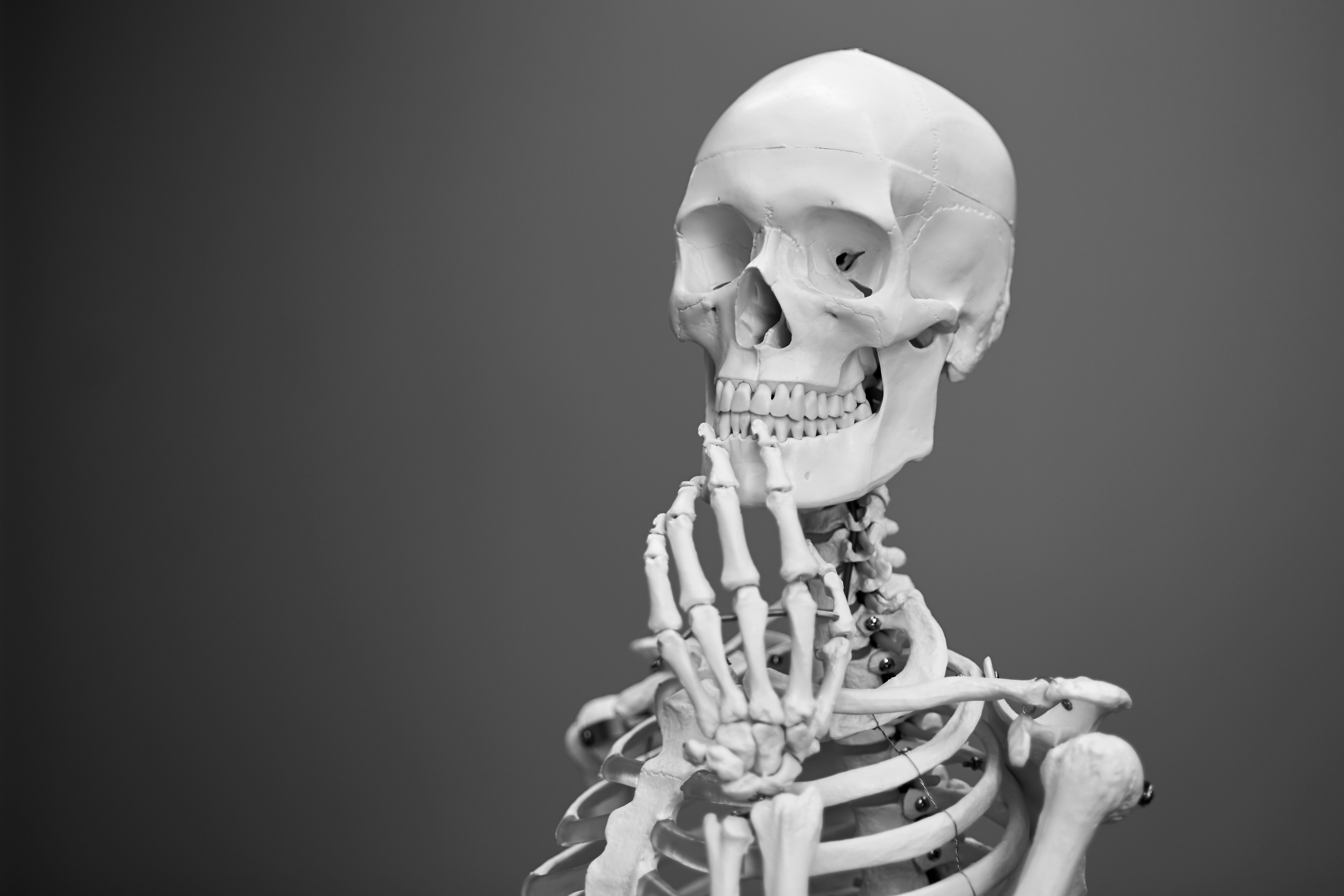
HYPE. There is a recurring pattern of hyping new finds in the field of human ancestry, says Luskin. When a fossil is first discovered it is enthusiastically promoted by the media as the latest human ancestor, but after a few years or even months “cooler heads” prevail, and scientists publish papers showing that earlier claims were not correct. This is especially true of the earlier hominins. At the turn of the millennium a fossil dubbed Orrorin tugenensis or “Millenium Man” was declared by the New York Times to be the earliest link yet between humans and early hominids. This was decided from a few bone scraps and part of a femur. A few years later a Yale University Press book remarked that there is very little evidence on how Orrorin ambulated: we don’t have enough evidence of its structure to say how it walked.
Another early hominin widely hyped was Ardipithecus ramidus. This was said in 2009 to be the earliest hominin and had the oldest human-like skeleton. Researcher Tim White at UC Berkely claimed that “Ardie” was “the Rosetta Stone” for understanding bipedalism. However, Time Magazine later reported that when Ardie was discovered she was in very poor shape. Some portions of the skeleton were found crushed and needed considerable “digital reconstruction”. The pelvis looked like an “Irish stew”, or like “roadkill” The pelvis is important to understanding how a creature walked. Later articles in scientific papers including “Science” and “Nature” showed that Ardie probably was not bipedal at all.
IN FUTURE…. Luskin, along with many other unbiased commentators, suggests that when the media hypes a new find we should take it with a grain of salt and see what the critics have to say in subsequent research.
AUSSIES. The Australopithecines are supposedly direct ancestors of our genus Homo. They are very ape-like, says Luskin, and their name literally means “Southern Ape”. They had brains about the size of a chimpanzee. The most famous skeleton from this genus is “Lucy”. Luskin says that Lucy and other Australopithecines are often portrayed as miniature humans with chimp-sized brains which walked on two legs. There are many Australopithecine traits that are ape-like, says Luskin, or at least not human-like, including their arms, hand bones, shoulders and toes, their brain size, their chest, their teeth, inner-ear canals and so on. In fact, says Luskin, they are very similar to modern apes which walk on all fours. Lucy was found, after a time, to be similar to a chimp or a gorilla, and the journal “Nature” proposed that they knuckle-walked. Lucy’s bones were found to be very suitable for climbing trees.
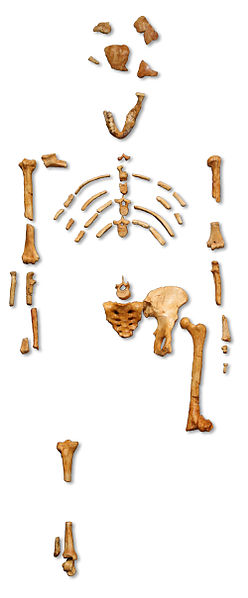
Luskin notes that Lucy’s pelvis was badly crushed. It was distorted. I shared in an earlier post about Lucy the work researchers did on her remains as revealed in a “Nova” documentary. The pelvis didn’t align with their theories, so they cut and repositioned the pelvis as they thought it should be in a creature learning to walk upright. What an eye-opener that was!
NO CHANGE. Luskin goes on to quote the Journal of Molecular Biology as saying that there are no gradual series of changes in earlier Australopithecines. He observes that there are no Australopithecines directly transitional to humans. He paraphrases London University anthropologist Leslie Aylo as saying that Australopithecines are “like apes” and the Homo group are “like humans”. There’s a gap here-the major point of Luskin’s lecture.
Another favorite “link” was Homo Habilis. However, Luskin again draws the line between early enthusiasm for the supposed “evidence” of human evolution and later reality. When you dig into the literature, he says, you find that Homo Habilis was more Australopithecus-like or more chimp-like than being similar to humans. This was the conclusion of a study in the journal “Science” in 1999. It should be classified as one of the ape-like Australopithecines.
In 2015 “Homo Naledi” was proposed as a new human ancestor. Many bones were discovered in South Africa. Naledi’s promotors initially suggested it lived around two to three million years ago. However, says Luskin, “That date was not from a geological analysis but from strictly evolutionary considerations”. In 2017 it was dated to one third that age. This date was necessary to fit into the proposed line of human ancestors. In this case, says Luskin, when the genus Homo does finally appear it appears in an “explosion” or rapid increase with punctuated change, with a sudden doubling of the brain size to achieve Homo status.
MIND THE GAP. Luskin says that “…earliest members of the genus ‘Homo’ were significantly and dramatically different from Australopithecines, and in virtually every element of its skeleton and every remnant of its behaviour the changes are sudden”. He reports how many of the details of the alleged transition to Homo aren’t known or are obscure. What we have is ape-like Australopithecines before and human-like Australopithecines after. There are no fossils documenting the supposed transition between the two. Instead, he says, we have “a transition based strictly upon the assumption of evolution”.

Luskin then concludes by discussing the “huge, unbridged gap”. Particularly early Hominins have no obvious ancestors, he says, and in most cases ancestor descendants cannot be reliably constructed.
EXCEPTIONAL. Luskin goes on to talk of “human exceptionalism”: the observation that the human race has always been unique and unparalleled in its moral, intellectual and creative abilities. Our complex language, tools that we use and our ability to use abstract reasoning, mathematics, poetry, religion and moral reasoning are all traits that only human beings have. Luskin explores this idea further in this video.
This post is a summary of the following YouTube video:
“The Unique Origins of Humanity in the Fossil Record” by Casey Luskin PhD, produced by @DiscoveryScienceChannel
Please see earlier post links of mine on human origins below.
Makeover with Lucy! – Fuel for Faith, Food for Thought
A Commentary on “In Our Time: Homo Erectus”. – Fuel for Faith, Food for Thought

