
The most recent video publication of “The American Gospel” does, for the most part, a service to the Church and the Word of God. However, I take exception to the episode used to preach Reformed theology, as though it were the gospel truth. To my mind this is an error almost as large as the one the video series attempts to address.

In an effort to right a faulty representation of the work of the Holy Spirit the presenters and participants of this video attack the practise of appealing to emotion in order to turn people into Christians. I whole-heartedly agree with the idea of avoiding emotive alter calls or dragging out ambient music in order to stir up emotions. However, as with all faulty teaching the baby is being thrown out with the bathwater. If you can’t feel some sort of emotion at the preaching of the cross and the sacrifice of Jesus there’s something wrong, and avoiding alter calls in order to avoid such conversions is possibly a denial of the Spirit’s work, not an aid to Him.
ELITE MASTERS OF THEOLOGY. Since, according to determined Reformed teaching or that of Calvinism, it’s God who zaps you with faith and you have nothing whatsoever to do with it, free will is anathema. This was the conviction of Calvin and Martin Luther, and modern-day Reformists are so determined to ratchet all of our theology to this point and never go back that they will look down on the one suggesting any measure of free will with scorn and accuse him/her of lacking any Biblical understanding. They have a very snooty and self-righteous view of their perceived lofty authority in the Church. They take the position in this video that there’s an either-or choice (Ha! Free will!) in your thinking: Either you believe the “truth” that salvation has nothing to do with your own will or you are an over-the-top Charismatic playing on people’s emotions and leading people to a false faith in Jesus.
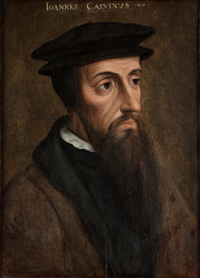
Calvinists hold up their hero as a little god, along with Luther, who preached choosing faith over works but denied free will. They apparently haven’t read Paul’s injunction not to follow any man (1 Corinthians 1:11-13).
Without doubt, in some charismatic circles emotion and feelings have become master. I’ve seen it and I know people in that way of thinking. I’ve written about it. I’m wary of it and I loathe it. I’ve encountered it in my childhood within the United Kingdom Salvation Army, long before the charismatic movement moved in and scattered the flock. I can’t stand the spectre of “contemporary” Christian music whipping up emotion and making people think that they are good Christians because they get fuzzy feelings when they raise their arms in the air and shed tears of delight at the “great” voices and the cute guitarist. But is this whipping up of emotion all evidence in support of the Reformist thinking? No, it is not.
DOES “ALL” REALLY MEAN “SOME”? I’ve written on the subject of free will before and will do so again. Today’s post isn’t meant to be a theological treatise: it’s more of an emotional (ha!) and logical one. When Jesus said that if he were lifted up he would draw “all” people to himself (John 12:32) I tend to believe it. And when Paul wrote that God wants “all” men to be saved and to come to a knowledge of the truth I tend to believe it:
“I urge, then, first of all, that petitions, prayers, intercession and thanksgiving be made for all people—for kings and all those in authority, that we may live peaceful and quiet lives in all godliness and holiness. This is good, and pleases God our Savior, who wants all people to be saved and to come to a knowledge of the truth. For there is one God and one mediator between God and mankind, the man Christ Jesus, who gave himself as a ransom for all people” (1 Timothy 2:1-6).
Paul’s actions were consistent with his words, so that when Agrippa said he was “almost persuaded” by Paul to become a Christian, Paul replied, “I would to God that not only you, but also all who hear me today, might become both almost and altogether such as I am, except for these chains” (Acts 26:28-29). Paul was “going for it”. He was preaching the gospel and giving altar calls. He wanted to bring people-all people-to Christ in any way possible.
PREACHING OR SHAM? Speaking of repentance, if God picks who will be saved from sin and who will not, wasn’t Christ’s preaching of the need for repentance a sham? Why bother if those hearing the message were incapable of repenting unless and until God sent that “quickening ray” which one participant of the American Gospel video alluded to? Doesn’t limited predestination mean that God is intentionally leaving some in their sin? What does this say about God? Why did John the Baptist preach repentance? Why bother and why risk your life if it’s down to God zapping the unwary and the unwilling with the Spirit’s power despite anything you can say and anything they think?
FAITH AND WORKS. Yes, atonement, regeneration and sanctification are all one hundred percent the work of God, and there is nothing we can do to make that happen. However, faith is not a work. Paul clearly separated the two. We are saved by our faith, not our works. Ah, but the Calvinist insists that God only offers faith to a few, and zaps those few unwary and unwilling souls accordingly. Oh, if only he would zap someone like Richard Dawkins, so that we could see him turn from rabid atheism to committed yet emotionless faith in one day.
If we respond to the Spirit of God we are regenerated by the Spirit of God who wishes, says Jesus Christ and Paul, to regenerate all of us.
Emotion can be deceptive, as I’ve written many times. It is therefore not to be used as a tool to make someone think that they have faith when they perhaps do not, and when they have not committed to turning from their godless life. However, if you can’t get emotional about the fact that the Lord of life and the creator of all things died for you, and loves you so much He wants to give you eternal life, what can you get emotional about?
BILLIONS. Apart from Scriptural consideration, the one determining factor in this free-will question for me is the sheer weight of numbers. If choosing to believe or loving the gospel message has nothing to do with salvation, it means that of the billions of people God brings into the world and blesses with souls He only selects a small minority for eternal life. His mercy only extends to a few: the rest can go to hell. It means that God gives life to billions of people only to send them straight to eternal and unending damnation without a single hope of salvation. It means that the sacrifice of Christ is limited and available to some, not to all. He didn’t die for the whole world after all. Accordingly Scripture has it wrong, or as some would say, “It doesn’t mean what it says” – the favourite claim of people wishing to change the obvious intent of Scripture.
I can’t end this rant without putting straight the gospel message. If you are reading this, Jesus Christ died for your sins, not just for someone else’s sins. He loves you and wants you to spend eternity with Him. He loves your family and friends and wants them all to come to a knowledge of the truth. Nothing you can do can please Him enough to accept you as you are-except one thing: you must accept His son, His only son Jesus Christ, into your heart and your life. You must turn from your old way of life and turn to Jesus. You must believe that God raised him from the dead, so that you too can have new and eternal life. This is the gospel of Jesus Christ-available to all.

