
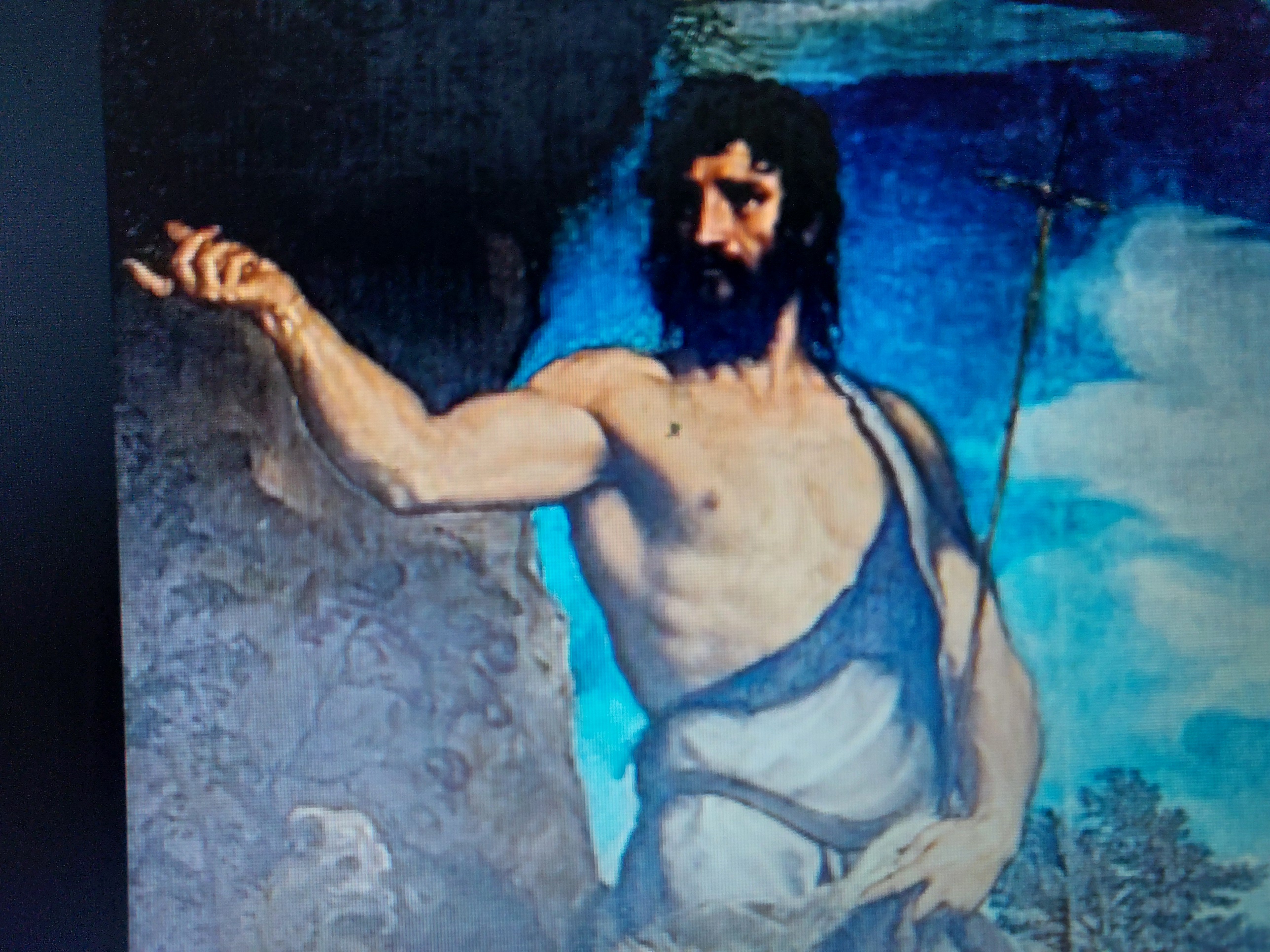
John the Baptist preached repentance and the coming Messiah. Matthew testifies that John was sent to “make straight the way of the Lord” (Matthew 3:3). This was in fulfillment of what Isaiah had prophesied eight hundred years before either John or Jesus were born. The “Lord” who John was to prepare the way for came in the form of Jesus. Some will claim that Jesus was merely representing the Lord. I will here show that Jesus was not just a representative but God’s only son in flesh.
Forgive me for any ugly ads or gaps added by WordPress software!
When John said, “After me will come one who is more powerful than I, whose sandals I am not fit to carry” (Matthew 3:11) he was talking about Jesus Christ. If anyone wants to doubt this there’s plenty of evidence to back it up. When John’s disciples told him that Jesus was gathering crowds he told them, “He must increase but I must increase” (John 3:30). When Jesus came to be baptized John told him, “I need to be baptized by you, and do you come to me?”. When he saw Jesus coming, he said to the crowd, “Behold, the Lamb of God!” When he was languishing in prison, he sent a message to Jesus asking if he were “the one”, or should we wait for another? Jesus’ answer is an unqualified “Yes”:
“Go back and report to John what you have seen and heard: The blind receive sight, the lame walk, those who have leprosy are cleansed, the deaf hear, the dead are raised, and the good news is proclaimed to the poor” (Luke 7:22).
Jesus was “the one” John was expecting. He said that the one coming after him would be “more powerful” than he, even though John was famous in the land and seen as a prophet. Most striking to me are his words, “…whose sandals I am not fit to carry”. He did not see Jesus as just another man, and since John was a prophet-in fact Jesus said that John was “more than a prophet” (Matthew 11:9) yet John looked up to Jesus and spoke of him with extreme reverence and awe.
Mark calls the Messiah “the Son of God”. He quotes God as saying through Isaiah that He would send his messenger ahead of this Son of God and would tell His messenger to “make straight paths for him” (Mark 1:1-3). So then, the “Lord” whose way John was to prepare was Jesus Christ – not just an earthly master as some try to define the word “lord” here, but the Son of God.

HE WILL BAPTIZE YOU WITH THE HOLY SPIRIT AND WITH FIRE. Only in today’s extremely charismatic churches do people believe that they can baptise others in or with the Spirit. However, it’s God who gives the Spirit. At Pentecost the Spirit was sent from heaven:
“When the day of Pentecost came, they were all together in one place. Suddenly a sound like the blowing of a violent wind came from heaven and filled the whole house where they were sitting” (Act 2:1-2).
“‘In the last days, God says,
I will pour out my Spirit on all people” (Acts 2:17).
While Peter brought to the Pentecost crowd’s attention how God had said He would pour out His Spirit, he went on to declare that Jesus had sent the Spirit from the throne of God ((2:33). At the Last Supper Jesus said that he would send the Spirit from heaven, but He also said that God would send the Spirit from heaven, and then he presented the event as coming from both the Father and the Son.
“But very truly I tell you, it is for your good that I am going away. Unless I go away, the Advocate will not come to you; but if I go, I will send him to you” (John 16:7).
“When the Advocate comes, whom I will send to you from the Father—the Spirit of truth who goes out from the Father—he will testify about me” (John 15:26).
“But the Advocate, the Holy Spirit, whom the Father will send in my name, will teach you all things and will remind you of everything I have said to you” (John 14:26).
How could Jesus have any part in sending the Holy Spirit of God-and that from heaven-if he were just another man or another prophet? How could he do that since he was about to be sacrificed on the cross? He would have to die and then go directly to the throne. How many people go directly to the throne of God when they die? Jesus isn’t getting confused here-neither is John in his writing. The message confirms what Jesus told his disciples, “I and the Father are one” (John 10:30). I don’t mean that Jesus was preaching a oneness gospel, but the reality of the Trinity.

THE JUDGE. John, speaking unmistakeably about the one coming after him (Matthew 3:11) used some imagery about Jesus which would be familiar to anyone who reads the Old Testament. He said that Jesus would “clear his threshing floor” by use, metaphorically of course (he didn’t own land), of his winnowing fork. He would “gather his wheat into the barn” and then burn up the chaff with “unquenchable fire” (verse 12). John was speaking of judgment and salvation. Whose threshing floor is John talking about? Whose wheat is it? Isn’t God the farmer and the owner of the harvest of souls? Doesn’t the “barn” which holds God’s wheat harvest – His people – belong to God? Why, then, is John describing Jesus as addressing “his” threshing floor, “his” wheat and “his” winnowing fork? Why is he seeing Jesus as the farmer, the owner of the farm, the winnower, and the judge? Biblically speaking the judge, the farmer and the owner of any metaphorical threshing floor affecting the souls of men and women is God:
“You have rejected me,” declares the Lord. “You keep on backsliding.
So I will reach out and destroy you; I am tired of holding back.
I will winnow them with a winnowing fork at the city gates of the land.
I will bring bereavement and destruction on my people, for they have not changed their ways” (Jeremiah 15:6-7).
THE CLINCHER. The determined skeptic finds ways to deny the following clear message given by God when Jesus Christ comes out of the water of baptism, and further than that, his subsequent mission. As Jesus emerged, we’re told that he (not everyone) saw the Spirit of God descending upon him. Then a voice came from heaven which said:
“This is my Son, whom I love; with him I am well pleased”.
Ask yourself then, if you consider that Jesus was just another child of God as we are, why you have not seen the Holy Spirit of God descending upon you or other people, and why a crowd around you hasn’t heard a voice from heaven declaring that you are the son of God. This was almost a unique event, apart from the fact that God similarly spoke from heaven about Jesus on the mount of Transfiguration. Not just anyone is God’s Son, but Jesus Christ is.
TACKLING THE DEVIL. Following Christ’s baptism and confirmation by the Father from heaven, we’re told that, “Jesus was led by the Spirit into the desert to be tempted by the devil” (Matthew 4:1). The devil’s first attack in this encounter was a mocking of Christ’s personage, saying, “If you are the Son of God, tell these stones to become bread”. Only in the mind of the most charismatic and extra-Biblical believer can just any old child of God turn stones into bread. Can you do it? Why did the devil suggest Jesus do it if he couldn’t? We know Jesus can do whatever he wants to do with bread because he fed over five thousand with three small loaves.
The devil was tempting Christ to demonstrate or “prove” who he was and so was appealing to the flesh. He wanted Jesus to flaunt his power and position by pandering to his own needs and worse-to do what Satan told the Son of God to do. But glory to the Lamb, Jesus refused to obey the enemy of all our souls.
What transpired in that desert was the opposite of the Fall of man as spoken of in Genesis. It was a colossal and profound event in which Jesus Christ demonstrated his authority, his perfection of holiness, his power over Satan and his obedience to the Father. Jesus was and is unique, and he is uniquely the Son of the living God.

